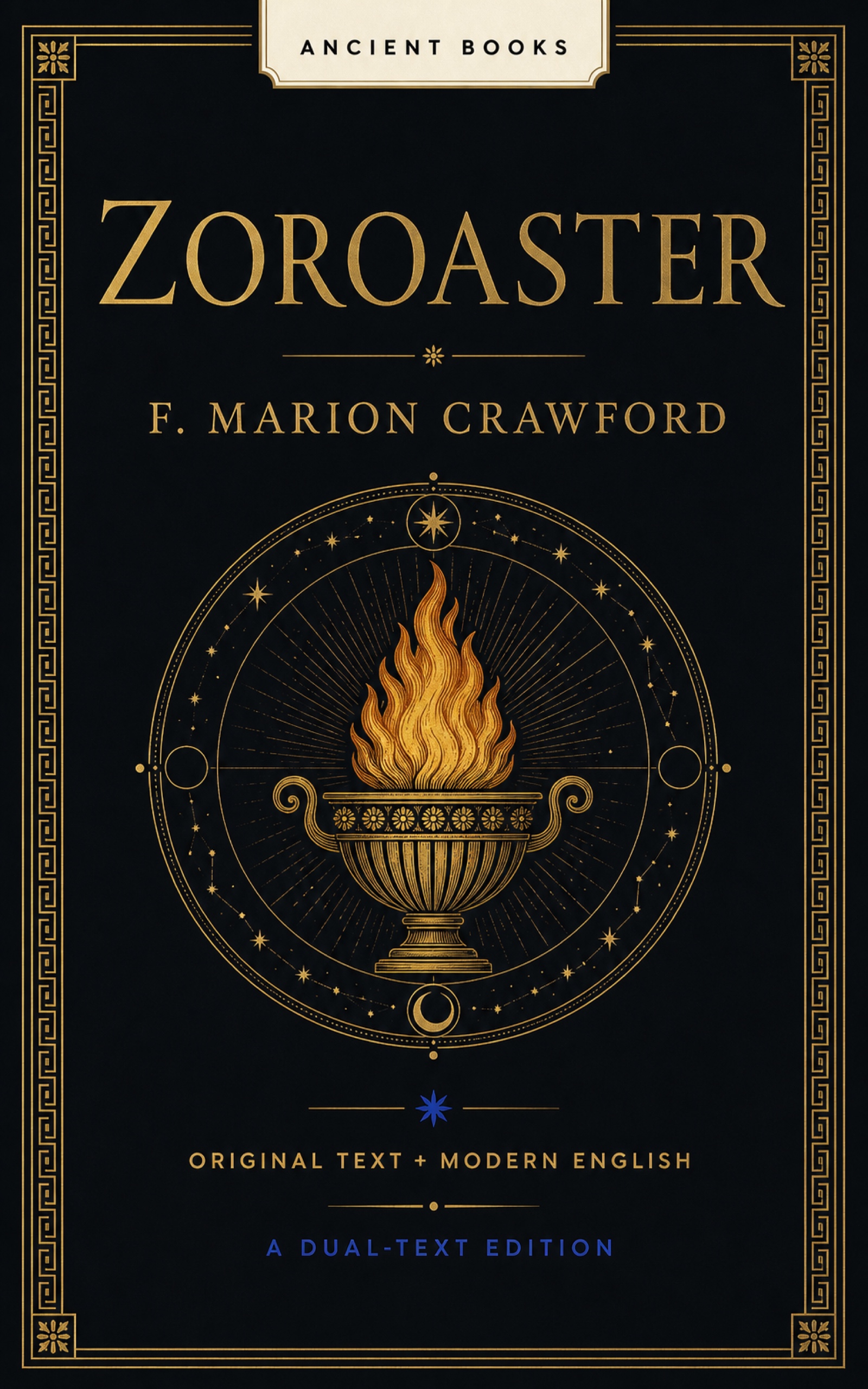
Identified source
London: Macmillan and Co., 1885; Internet Archive zoroaster00crawrich, reconciled with Project Gutenberg 16720.
Open the public source record ↗
Cover asset: 1600 × 2560 · full 5:8 frame
Ancient Books production page
Agent editorial draftCrawford’s Zoroaster is a historical novel set in the ancient Persian world. It is not a primary Zoroastrian scripture, a scholarly edition of Zarathustra’s teachings, or a book titled Original Teachings of Zoroaster. The adaptation must clarify obsolete phrasing without converting fiction into history.
A genuine context-aware Modern English agent draft covers all 22 packets and all 1,217 trace-bound units, preserving dialogue, liturgy, footnotes, and fictional framing. All structural validators pass; facsimile and human editorial review remain incomplete.
No file on this page is represented as human-approved or publication-ready.
Source provenance
London: Macmillan and Co., 1885; Internet Archive zoroaster00crawrich, reconciled with Project Gutenberg 16720.
Open the public source record ↗Exact Internet Archive source confirmed by embedded identifiers and byte-level page comparison; a clean public-domain reading text is used for reconciliation.
All 1,217 reconciled paragraphs are hash-bound in 22 deterministic editorial packets.
Scan-to-reading-text differences and flagged passages require facsimile confirmation before release.
Editorial record
Crawford’s Zoroaster is a historical novel set in the ancient Persian world. It is not a primary Zoroastrian scripture, a scholarly edition of Zarathustra’s teachings, or a book titled Original Teachings of Zoroaster. The adaptation must clarify obsolete phrasing without converting fiction into history.
Agent output remains an editorial draft. Mechanical substitutions are never counted as a completed Modern English adaptation.
Ancient Books returns historically significant and hard-to-find works to active reading. Older books often survive either as page images—faithful to the physical artifact but difficult to search and navigate—or as raw machine-readable text that may hide transcription errors. Our editorial aim is to preserve the historical record while making it easier for contemporary readers to enter, study, and discuss.
Bringing a book back to life does not mean rewriting its author’s ideas to fit the present. It means presenting the historical text clearly, identifying the limits of the source, and building a transparent bridge across changes in vocabulary, syntax, references, and assumptions.
Original transcription preserves the identified source edition’s wording and sequence, except where a documented technical correction is necessary. Modern English restates each passage in clear current prose while retaining its claims, tone, and uncertainty. Bounded editorial notes identify unfamiliar references, consequential wording choices, or unresolved transcription problems.
The adaptation is a reading aid, not a replacement for the historical text. Notes remain separate from the author’s words and do not certify historical, scientific, medical, theological, or institutional claims.
OCR can confuse letters, punctuation, columns, footnotes, headers, and reading order. Agent-assisted tools may help draft adaptations, locate inconsistencies, or prepare notes, but neither OCR nor agent output is treated as an authority. Proposed corrections and adaptations are compared with the source and must be reviewed by a human editor before publication; meaningful uncertainty stays visible rather than being guessed away.
In this project, ‘original’ means the wording of the identified historical source edition or translation. It does not necessarily mean an authorial manuscript, a first edition, or text in the work’s earliest language. Each title note states the relevant limitation.
Edition formats
Protected download
Amazon detail page
Narrated edition
Checkout, protected delivery, refunds, and entitlement revocation are being tested behind release gates. Purchasing stays closed until the reviewed PDF and live payment configuration both pass.